Summary
Proper cleaning and disinfection of ultrasound probes are essential for patient safety and for protecting the lifespan of the equipment. Because probes come into contact with skin, mucous membranes, and sometimes sterile tissues, they can spread infection if they are not reprocessed correctly between patients.
Current guidance is clear that cleaning comes first: gel, debris, and other bioburden must be removed before disinfection can work as intended, even when a probe cover was used.
Introduction
An ultrasound probe, or transducer, turns electrical energy into sound waves and then converts the returning echoes back into images, and understanding what an ultrasound probe is helps clarify why careful cleaning and disinfection are essential after every examination. Because the same probe is used repeatedly on different patients, it can also become a vehicle for bacteria, viruses, fungi, and other contaminants if cleaning and disinfection are incomplete. That is why probe reprocessing should never be treated as a quick wipe-down at the end of the day. It is a clinical safety process that starts immediately after each exam.
Most infection-control guidance organizes probes using the Spaulding classification. Non-critical probes contact intact skin and generally require low-level disinfection. Semi-critical probes contact mucous membranes or non-intact skin and require high-level disinfection. Critical probes enter sterile tissues or the bloodstream and should be sterilized when possible. This framework helps clinics match the reprocessing method to the actual risk of infection transmission.
Understanding Probe Categories and Disinfection Levels
The first question is always simple: what did the probe touch?
Probes used on intact skin, such as many abdominal, musculoskeletal, or vascular transducers, are considered non-critical, and clinicians working with different probe designs, like those discussed in linear vs convex ultrasound probes, still need to follow the same careful cleaning workflow after each patient. These still need careful cleaning after every use, followed by low-level disinfection. Low-level disinfection is appropriate here because the probe contacted intact skin rather than a high-risk site.
Probes used in endocavitary studies, including transvaginal, transrectal, and transesophageal examinations, are semi-critical because they contact mucous membranes.
These require high-level disinfection between patients, even when a cover is used. Covers reduce contamination risk, but they do not eliminate it, and they do not change the classification of the probe.
Probes used in sterile body cavities or during invasive procedures are considered critical. When feasible, they should be sterilized. If sterilization is not possible for the specific device, high-level disinfection must be combined with a sterile cover and sterile gel for the procedure.
Pre-Cleaning at the Bedside
Good reprocessing starts immediately after the exam, not later in the reprocessing room. The probe cover should be removed and discarded, and excess gel or visible debris should be wiped away right away. AIUM guidance recommends removing bulk gel and soil first, because dried organic material makes later disinfection less effective.
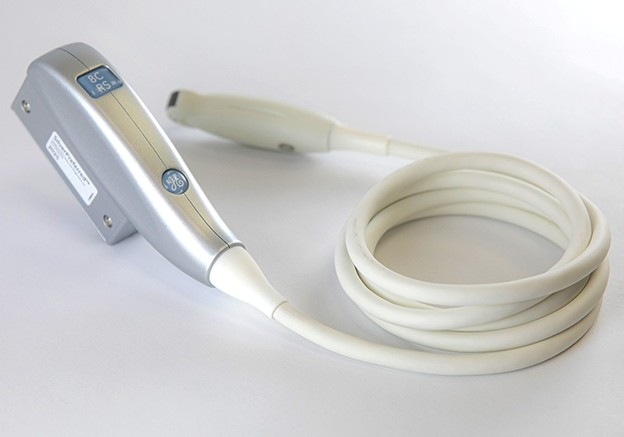
At this stage, it is also worth inspecting the probe head, handle, cable, and strain relief for cracks, tears, or other damage, since these components are critical ultrasound machine parts that directly affect both image quality and safe reprocessing. Damaged surfaces are harder to clean properly and can shelter microorganisms. They may also increase the chance of sheath failure and reduce image quality.
Cleaning: Removing Gel, Soil, and Bioburden
Cleaning is the most important step because disinfectants cannot work properly through dried gel, blood, or other organic material. The probe should be cleaned using a manufacturer-approved detergent or enzymatic cleaner, applied with a soft cloth, sponge, or gauze. Every accessible surface should be wiped carefully, including crevices and angled areas where residue can collect.
Immersion should only be used when the manufacturer specifically allows it, and only to the depth approved in the instructions for use. Cables, connectors, and other non-immersible components can be damaged if they are submerged or cleaned with the wrong product. That is why the probe manufacturer’s instructions for use should always take priority over generic habits or local shortcuts.
Harsh or incompatible chemicals can damage the acoustic lens, housing, adhesives, and seals. AIUM specifically advises users to follow compatibility information because some common chemicals may shorten probe life or cause failure.
In practice, alcohol is not universally prohibited, but many probes are not compatible with alcohol-based products, so it should never be used unless the manufacturer explicitly allows it.
Even when a sheath was used, the probe still needs full cleaning. Probe covers can fail or leak. Earlier studies found perforation rates ranging from low single digits to much higher depending on the type of cover and procedure, and a 2025 cohort study still reported measurable post-procedure perforation rates. That is why covers are treated as an extra barrier, not a substitute for reprocessing.
After cleaning, the probe should be rinsed as directed to remove detergent residue and then dried with a lint-free cloth or other approved material before moving to the disinfection step.
Disinfection and Sterilization
Once the probe is visibly clean and dry, the next step is choosing the correct level of disinfection.
Low-Level Disinfection
Low-level disinfection is used for probes that contact intact skin only. This process is designed to inactivate most vegetative bacteria, some fungi, and many viruses when the product is used correctly and left in contact for the full required time. Clinics commonly use approved wipes or liquid disinfectants for this purpose, but the exact product and contact time must match both the disinfectant instructions and the probe manufacturer’s compatibility list.
If a liquid product is used and the instructions call for rinsing afterward, that rinse step should not be skipped. Residual chemicals can irritate patients and may also affect the surface of the transducer over time.
High-Level Disinfection and Sterilization
High-level disinfection is required for semi-critical probes and for probes used in many invasive applications when sterilization is not possible. It is intended to destroy all microorganisms except high numbers of bacterial spores. The process typically involves a validated chemical system or automated reprocessor using a compatible high-level disinfectant for the full exposure time specified by the manufacturer.
Sterilization is preferred for critical probes whenever the device can tolerate it and the clinical workflow allows it. If sterilization is not feasible, the accepted alternative is high-level disinfection paired with a sterile barrier and sterile gel for the procedure. This is especially important in sterile cavity or interventional use, where the consequences of contamination are much greater.
Staff should also use appropriate PPE and ensure proper ventilation when working with chemical disinfectants. Some reprocessing agents can irritate the skin, eyes, or respiratory tract if handled carelessly.
Rinsing and Drying
Rinsing and drying may sound like small finishing steps, but they are part of safe reprocessing. After disinfection, the probe should be rinsed according to the disinfectant instructions using the correct quality of water, then dried thoroughly with a clean lint-free cloth or approved drying method. Residual disinfectant can harm patients, and residual moisture can interfere with future reprocessing or support microbial survival in storage.
Storage and Transport
A clean probe can be re-contaminated quickly if it is stored badly. Reprocessed probes should be kept in a clean, dry area that is physically separate from dirty equipment and used instruments. Storage systems should protect the probe from environmental contamination and from avoidable damage to the cable or lens.
When probes are moved between the scan room and the reprocessing area, transport containers should clearly separate clean from dirty items. That separation sounds basic, but it is a common weak point in busy clinical environments.
Documentation and Traceability
A reliable reprocessing system needs more than good intentions. It needs documentation. For probes requiring high-level disinfection or sterilization, records should include the probe identity, date and time of reprocessing, the person who performed it, the method used, and any verification steps required by the disinfectant system or local policy.
Traceability matters because it supports quality assurance and allows clinics to respond quickly if there is a reprocessing failure, equipment fault, or infection-control incident.
Best Practices and Safety Tips
Always follow the probe manufacturer’s instructions for use, and incorporating practical ultrasound maintenance tips to extend lifespan can also help protect probes from avoidable damage during cleaning and routine use. Different models have different materials, seals, immersion limits, and chemical compatibility, so the safest disinfectant for one probe may damage another.
Use appropriate PPE during reprocessing. Gloves are the minimum, and eye or face protection may also be needed depending on the product and the risk of splashing or fumes.
Use sterile, single-use gel for sterile or invasive procedures and follow current guidance for gel handling in all other settings. AIUM emphasizes safe gel use because contaminated gel and poorly handled multi-use containers have been linked to infection risk.
Clean the rest of the ultrasound system too. Keyboards, touchscreens, probe holders, cables, and gel bottle tips can all become contaminated and should be included in the cleaning workflow. Ancillary equipment is easy to overlook, but it can contribute to cross-contamination.
Train staff and audit the process. Even good protocols fail if they are not followed consistently. Competency-based training, written SOPs, and periodic audits help close the gap between policy and daily practice.
Inspect probes and cables regularly. If a probe is cracked, torn, delaminated, or otherwise damaged, it should be removed from service until it is assessed and repaired, and clinics often rely on specialized ultrasound probe repair services to restore equipment safely. Damaged surfaces are harder to disinfect and more likely to fail clinically.
Conclusion
Safe ultrasound probe reprocessing starts with prompt pre-cleaning, followed by careful cleaning that removes gel, debris, and bioburden before disinfection begins. From there, the correct reprocessing pathway should be chosen according to probe classification and clinical use: low-level disinfection for probes used on intact skin, and high-level disinfection or sterilization for probes that contact mucous membranes, non-intact skin, or sterile tissues.
Rinsing, drying, storage, and documentation are not optional extras. They are part of the same infection-control chain. Clinics that follow manufacturer instructions, use compatible products, train staff well, and document the process consistently protect both patients and equipment far more effectively than clinics that rely on shortcuts or habit.
Frequently Asked Questions
-
Do I still need to clean the probe if I used a sheath?
Yes. A sheath reduces contamination risk, but it does not replace cleaning and disinfection. Covers can leak, tear, or develop micro-perforations, so the probe still requires full reprocessing after use.
-
What cleaning agents are safe for ultrasound probes?
Only agents that are approved in the probe manufacturer’s instructions for use should be used. In general, mild detergents, approved enzymatic cleaners, and compatible disinfectant products are acceptable, but the exact answer depends on the probe model.
-
When should I use high-level disinfection instead of low-level disinfection?
High-level disinfection is required when a probe contacts mucous membranes or non-intact skin, and it is also used for many invasive applications when sterilization is not possible. Low-level disinfection is generally reserved for probes used only on intact skin.
-
Can I use alcohol to disinfect my probe?
Not unless the manufacturer specifically says that alcohol is compatible with that probe. Some devices tolerate certain alcohol-based products, but many do not, and using the wrong chemical can damage the lens, adhesives, or housing.
-
How should probes be stored after disinfection?
They should be kept in a clean, dry storage area that is separate from contaminated equipment and handled in a way that protects them from re-contamination and physical damage. Clean and dirty probes should never be mixed during storage or transport.