Summary
Mindray has become a serious name in diagnostic ultrasound, with systems that range from premium cart-based platforms to portable units and handheld scanners, including a wide range of Mindray ultrasound systems for sale designed for different clinical needs. One of its best-known technologies, ZONE Sonography Technology Plus, or ZST+, is designed to improve image quality by capturing more acoustic data and applying advanced focusing throughout the image. When you combine that with a five-year warranty on many systems, software-driven upgrades, and a price point that is often more competitive than other major brands, it is easy to see why Mindray has gained so much attention.
Introduction
Mindray was founded in 1991 and has grown into one of the biggest medical device manufacturers in the world. Its ultrasound lineup now covers a wide range of clinical needs, including full console systems for radiology and OB/GYN, portable machines for shared service and bedside imaging, and handheld devices for point-of-care use.
Part of Mindray’s appeal is that it focuses on offering advanced imaging and workflow tools without pushing buyers into the highest pricing tier in the market. For hospitals, clinics, and imaging providers looking for strong performance and long-term value, that combination has made Mindray an increasingly attractive option.
This article looks at the technologies behind Mindray ultrasound, highlights some of the company’s key product lines, and explains why many facilities consider the brand a serious alternative to more established premium manufacturers.
Key Technology and Innovations
ZONE Sonography Technology Plus (ZST+)
At the center of many Mindray systems is ZST+, a beamforming platform that came out of the company’s acquisition of ZONARE. Unlike traditional ultrasound systems that build images line by line, ZST+ works by capturing larger zones of acoustic data and processing the full channel information.
In practical terms, that approach is meant to improve image uniformity, resolution, and speed. Mindray says ZST+ allows the system to collect up to 90 percent more acoustic data per frame and speed up acquisition significantly. That wider pool of data supports several important functions:
Dynamic Pixel Focusing
Each pixel is focused at every depth and in every frame, helping the image stay clear and consistent from near field to deeper anatomy.
Sound Speed Compensation
This is a one-touch function that adjusts for the actual sound speed in tissue, helping improve both spatial and contrast resolution.
Total Recall Imaging
Raw channel data can be saved, which allows post-processing later without needing to rescan the patient.
ZST+ is a major part of higher-end Mindray platforms like the Resona series and DC-80, and parts of the same approach also appear in portable models such as the MX7.
Single-Crystal and 3T Transducers
Mindray has also put a lot of attention into probe design, and understanding what an ultrasound probe is helps explain why transducer performance plays such a key role in image quality. Its single-crystal transducers with 3T technology are designed to improve both penetration and resolution, especially in more challenging patients.
The idea is to widen the bandwidth while maintaining image detail at depth. Mindray also offers ComboWave transducers, which use composite materials to improve the acoustic spectrum and reduce impedance. In everyday use, this translates to more consistent image quality and better performance across a wider range of exams.
Living Technology and Warranty
One of the more distinctive parts of Mindray’s offering is what it calls the Living Technology program. The company treats many of its ultrasound systems as upgradeable platforms rather than fixed products.
During the five-year warranty period, customers receive software upgrades and performance improvements at no extra cost. That warranty also typically covers replacement parts, transducers, and on-site labor for cart-based repairs. For many buyers, that matters just as much as the hardware itself, because it helps control maintenance costs and improves long-term value.
Mindray Product Lines
Premium Console Systems: Resona 7 and DC-80
Resona 7
The Resona 7 is one of Mindray’s premium imaging platforms for radiology and general ultrasound. It is built around the ZST+ engine and is aimed at users who want strong B-mode imaging, sensitive Doppler, and a full set of advanced tools.
The system includes workflow features like a gesture-enabled touchscreen, an electronically adjustable control panel, and a tilting multi-touch display. It also supports tools such as HD Scope, HR Flow, iNeedle, Smart OB, Smart FLC, and 3D/4D imaging.
In simple terms, the Resona 7 is designed for practices and departments that want a high-end system with both imaging performance and workflow efficiency.
DC-80
The DC-80 sits just below the Resona line, but it still offers a very advanced feature set. It uses single-crystal transducers with 3T technology and supports tools like elastography, contrast-enhanced imaging, and a range of automated measurement functions.
Features such as Sound Touch Elastography, Sound Touch Quantification, Smart FLC, Smart Track, and Smart Planes CNS help bring more premium-style functionality into a system that is positioned at a slightly more accessible level.
For buyers who want strong imaging and automation without moving all the way to Mindray’s flagship tier, the DC-80 is often one of the more interesting systems in the lineup.
High-End Portable: M8 Elite
The M8 Elite is one of Mindray’s better-known portable systems and is built for users who want premium imaging in a smaller form factor, fitting into the broader category of portable ultrasound machines types used across clinical settings.
It includes single-crystal probes, 3T technology, Echo Boost, 3D/4D imaging, contrast imaging, and onboard storage. The machine itself is compact, with a 15.6-inch monitor, built-in battery support, and a magnesium alloy body for durability.
This makes it a strong fit for practices that need portability but do not want to give up too much in terms of image quality or advanced features. It is often considered a good option for cardiology, vascular, OB/GYN, and shared-service imaging.
Mid-Range Portable: MX7 and ME8
The MX7 and ME8 are mid-range portable systems that carry over much of Mindray’s imaging approach into a lighter and more mobile platform.
The MX7, for example, has a slim design, long battery life, and features such as voice command support, programmable probe buttons, touchscreen controls, and advanced image enhancement tools like HD Scope, Echo Boost, and HR Flow.
These systems are particularly appealing for bedside use, shared service, and point-of-care environments where mobility matters but image quality still needs to stay strong.
Point-of-Care System: TE7
The TE7 is designed specifically for emergency and critical care use. Rather than using a traditional console layout, it relies heavily on a touch-based interface and is built around a smaller cart.
Its anti-glare display, gesture controls, quick boot-up, and preset protocols make it especially useful for FAST exams and other rapid bedside assessments. It also supports advanced modes such as color Doppler, power Doppler, continuous-wave Doppler, and even TEE capability.
This system is clearly aimed at clinicians who want a fast, easy-to-clean, easy-to-use ultrasound platform in busy care settings.
Handheld Ultrasound: TE Air
At the smallest end of the range is the TE Air, Mindray’s handheld ultrasound device. It connects wirelessly to iOS and Android devices and is designed for point-of-care scanning in a highly portable format.
Mindray and third-party sources highlight features such as iClear, iTouch, Smart Bladder, quick charging, IP68 protection, and support for multiple imaging modes. The device is built to deliver practical handheld imaging for applications like cardiac, abdominal, thoracic, urology, and bedside assessment.
The TE Air will not replace a full-size machine for more advanced work, but it gives clinicians a very portable option when speed and convenience are the priority.
Warranty and Support
One of Mindray’s biggest selling points is its standard five-year warranty on many ultrasound systems, especially in North America.
That warranty generally includes the main unit, standard transducers, software upgrades, and on-site labor for cart-based systems. Because ultrasound service contracts can be expensive, this longer warranty can make a noticeable difference in total cost of ownership, especially when combined with practical ultrasound maintenance tips to extend lifespan to reduce long-term service needs.
For many facilities, especially those without large in-house service teams, that level of support adds real peace of mind.
Insights and Considerations
Value for Money
Mindray has built much of its reputation around value. The company offers advanced imaging tools, modern workflow features, and a long warranty while often pricing below some of the best-known premium brands.
For buyers who want features like elastography, 3D/4D imaging, advanced Doppler, and intelligent automation without paying top-tier prices, Mindray is often seen as a strong option.
Workflow and Ergonomics
Mindray has clearly put effort into usability. Adjustable panels, gesture-based displays, voice controls, touchscreen workflows, and automated tools all help reduce friction during exams.
That may sound like a small detail, but in busy environments it can make a meaningful difference in how comfortable and efficient a system feels day to day.
A Full Range of Portability
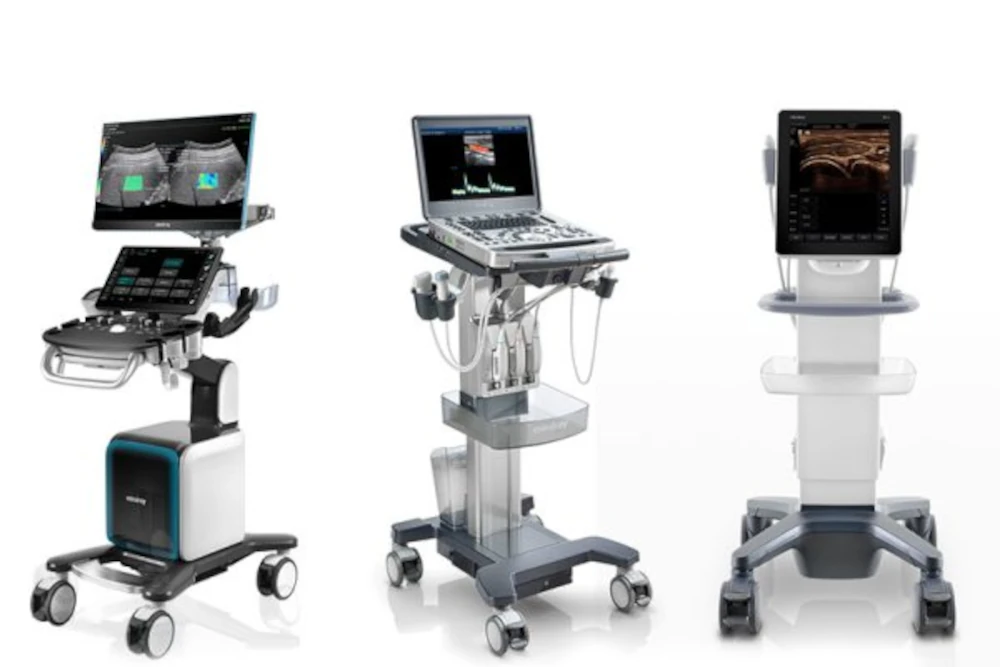
Another strength is the breadth of the lineup. Mindray covers everything from full console systems to portable laptops to true handheld devices.
That gives buyers more flexibility. A radiology department, a hospital ward, and a field-based clinician may all have very different needs, and Mindray has a system positioned for each of those environments.
Limitations
Mindray offers strong value, but it is not always the automatic choice for every specialty or every buyer. Some users may still prefer GE, Philips, or other long-established brands for certain advanced applications, especially where deep specialization or a familiar service ecosystem matters.
Also, while portable and handheld Mindray systems are convenient, they still come with the usual trade-offs in battery life, footprint, and image performance compared with larger premium consoles.
That is why it is important to look beyond the brand name and evaluate the actual imaging needs, workflow, probe options, and local support available to your facility, following a structured approach like this veterinarian’s guide to choosing the right ultrasound machine.
Conclusion
Mindray has become a major player in ultrasound by combining advanced beamforming, strong probe technology, useful workflow tools, and one of the more generous warranty offerings in the market.
Systems like the Resona 7 and DC-80 bring high-end imaging and automation to radiology and general imaging. Portable models like the M8 Elite and MX7 give users a strong mix of mobility and performance. Meanwhile, the TE7 and TE Air extend ultrasound into point-of-care and handheld use cases where speed and portability matter most.
For clinicians and facilities trying to balance image quality, portability, and long-term value, Mindray is a brand worth taking seriously.
Frequently Asked Questions (FAQ)
-
What makes ZST+ different from traditional beamforming?
ZST+ works by collecting larger zones of acoustic data rather than building the image line by line. That allows features like dynamic pixel focusing, sound speed compensation, and post-processing of saved raw data, which can improve image consistency and workflow.
-
Do Mindray systems really come with a five-year warranty?
Many of them do, especially in North America. The warranty commonly includes the main unit, standard transducers, software updates, and on-site labor for cart-based systems.
-
Are Mindray ultrasound machines a good value?
Many facilities think so. Mindray systems are often seen as offering strong imaging performance, advanced tools, and long warranty coverage at a price that is more competitive than some larger premium brands.
-
Which Mindray system is best for emergency medicine?
The TE7 and TE Air are the most obvious choices for emergency and point-of-care use. The TE7 is better suited to a dedicated clinical environment, while the TE Air is built for handheld mobility.
-
What should I consider when choosing a Mindray ultrasound machine?
Start with your clinical focus, portability needs, budget, and feature requirements. Premium systems are better for advanced imaging and high-volume use, portable systems offer a balance of mobility and performance, and handheld options are best when convenience and immediate access matter most.