Summary
Canon and Mindray can both be considered for veterinary ultrasound, but they usually appeal to different buyers. Canon may suit clinics looking for advanced imaging performance and specialty capabilities, while Mindray may suit veterinary practices wanting a broader veterinary-focused range, including portable and cart-based systems.
Introduction
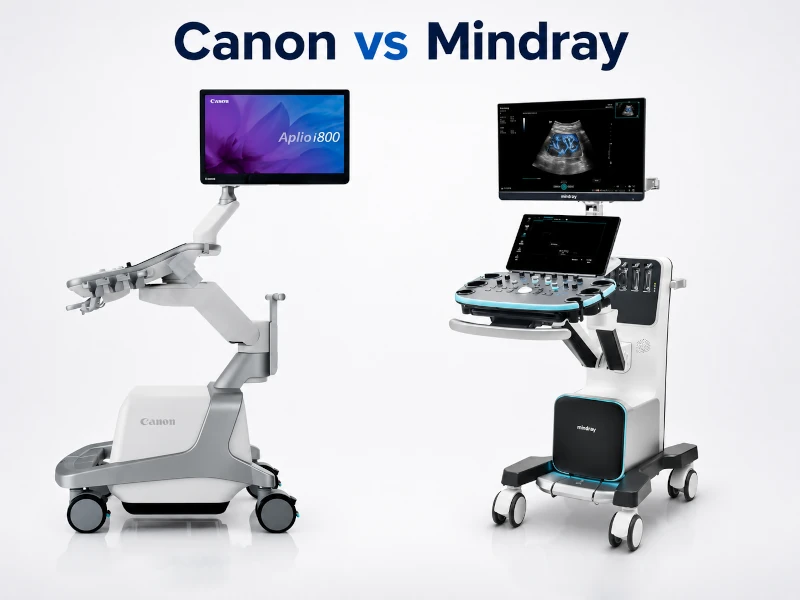
Canon vs Mindray is not a simple “better brand” comparison. Canon Medical is widely known for advanced clinical ultrasound platforms such as the Aplio i-series, Aplio a-series, and Aplio flex. Mindray Animal Medical, on the other hand, offers Mindray veterinary ultrasound systems designed specifically for animal care workflows.
Canon describes the Aplio i-series / Prism Edition as offering AI-assisted productivity and imaging functions, while Aplio flex is positioned as a mobile system with smart imaging and workflow functions for busy clinics. Mindray lists veterinary ultrasound systems such as Vetus E7 and Z60 Vet, with systems designed for mobility, veterinary workflow, and animal care environments.
This guide compares Canon and Mindray by clinical fit, image quality, veterinary workflow, portability, probe needs, used/refurbished value, and long-term support.
Quick Verdict: Canon or Mindray?
Canon may be the better fit for specialty clinics, referral hospitals, advanced small animal imaging, cardiology, exotic animal imaging, and practices that want premium imaging tools from a major medical imaging brand.
Mindray may be the better fit for general veterinary clinics, mixed practices, buyers who want veterinary-specific systems, and practices comparing portable and cart-based ultrasound options at different price levels.
The right choice depends on the same factors involved in choosing the right veterinary ultrasound system: the exact model, probes, software options, condition, support, and the exams your practice performs most often. A high-end Canon system may be excellent for referral imaging, but a Mindray veterinary system may be more practical for a general clinic that needs species presets, daily usability, and a simpler veterinary workflow.
The Main Difference: Advanced Medical Platform vs Veterinary-Focused Range
Canon is often considered when a veterinary clinic wants advanced imaging capability, especially if the buyer is looking at premium clinical ultrasound systems that can also fit veterinary applications. The Aplio i-series / Prism Edition includes flexible AI-assisted productivity functions, imaging tools, and workflow customisation. Aplio flex is described as a mobile system with smart imaging and workflow functions for a wide variety of imaging needs in busy clinics.
Mindray is easier to position directly inside veterinary care because Mindray Animal Medical offers a dedicated veterinary ultrasound lineup. Its veterinary systems include portable and hand-carried options such as Vetus E7 and Z60 Vet, and Mindray describes the Vetus E7 as a laptop-based system designed for mobility and reliability in a compact format.
Canon feels more like a premium clinical imaging option that may suit advanced veterinary environments. Mindray feels more like a veterinary-focused option that may suit a wider range of everyday clinic and mixed-practice workflows.
Where Canon Has the Advantage
Canon may stand out when the buyer needs high-end image quality, advanced Doppler or vascular imaging tools, specialty small animal imaging, cardiac or referral-level workflows, exotic animal imaging, premium software tools, or a used/refurbished system with strong imaging potential.
Canon has also published veterinary imaging examples involving Aplio systems. One Canon article describes the Aplio i800 being used in exotic animal care for abdominal and thoracic exams, ultrasound-guided biopsies, nerve blocks, and echocardiography. The same example highlights high-resolution imaging, high-frequency transducers, and a wide transducer range as important factors in that setting.
Best Canon Fit
Canon may be a stronger choice for referral hospitals, specialty veterinary clinics, advanced small animal practices, exotic animal clinics, veterinary cardiology users, and buyers considering premium refurbished ultrasound systems.
Canon makes the most sense when a practice can actually use the advanced capability. A general clinic doing only basic screening may not need the same system as a referral hospital performing complex abdominal, cardiac, or guided-procedure work.
Where Mindray Has the Advantage
Mindray may stand out when the buyer wants veterinary-specific ultrasound systems, portable and cart-based choices, dedicated veterinary parameters, a broader range of models at different price levels, and systems designed directly for animal care environments.
Mindray’s veterinary lineup includes hand-carried and portable systems such as Vetus E7 and Z60 Vet, along with wider Vetus-series options. The Z60 Vet is described as a portable Color Doppler veterinary ultrasound system with image quality and advanced features, while the Vetus E7 is described as a compact laptop-based veterinary ultrasound system. Mindray’s Vetus 8 is also presented as a professional veterinary solution for a wide range of species, from small pets to large farm animals.
Best Mindray Fit
Mindray may be a stronger choice for small animal clinics, general veterinary practices, mixed practices, clinics wanting a balance of value and features, buyers needing portable or cart-based choices, and practices looking for veterinary presets and workflow support.
Mindray is often easier to evaluate as a veterinary purchase because the product range is already positioned around animal care rather than adapted from a general medical imaging platform.
Image Quality: Do Not Compare by Brand Name Alone
Canon may have the stronger premium-imaging reputation, especially in advanced clinical systems, but that does not automatically make every Canon system the better veterinary purchase. A newer, properly configured Mindray veterinary system may be more useful for a clinic than an older Canon system without the right probes or software.
At the same time, a well-maintained refurbished Canon system may offer excellent value for a specialty clinic that needs higher-end imaging. Canon’s Aplio i-series materials describe enhanced resolution, penetration, expert tools, and microvascular imaging technology for low-flow visualisation. These features may matter for specialist cases, but only if the veterinary team has the probes, training, and workflow to use them.
Buyers should compare sample images from the exact machine, probe quality, imaging depth, Doppler performance, software packages, display quality, workflow speed, and service history. The better image is not always from the more famous brand; it usually comes from the right system, right probe, correct settings, and experienced user.
Veterinary Workflow: Where Mindray May Feel Easier
Workflow matters, especially in a clinic where multiple staff members may use the machine. Mindray has an advantage when the buyer wants a system designed directly around veterinary use, species-oriented workflow, and animal care needs.
Mindray’s Vetus 8 materials describe the Vetus series as professional veterinary solutions for a wide variety of species, from small pets to large farm animals. For many general clinics, that direct veterinary positioning may make the buying process simpler. Buyers can look at species needs, probe options, presets, and workflow features without needing to adapt a human-focused system.
Canon may still work very well in veterinary settings, but buyers should confirm that presets, measurements, reporting, image export, and probe options fit the way the clinic scans animals.
Specialty Imaging: Where Canon May Pull Ahead
Canon becomes more interesting when the clinic is not only doing basic abdominal scans. Canon may be more attractive for advanced abdominal imaging, cardiac imaging, exotic animal imaging, microvascular imaging, guided procedures, referral-level diagnostics, and specialist soft tissue exams.
Canon’s Aplio i800 example in exotic animal care is especially relevant because it includes abdominal and thoracic exams, biopsies, nerve blocks, and echocardiography. It also notes the use of high-frequency probes, including a 22 MHz hockey-stick transducer for very small patients. Canon’s advanced application materials also describe tools for interventional procedures, including Smart Fusion, Smart Navigation, and virtual biopsy-line guidance.
Canon is not automatically better for every specialty practice, but it may be better suited when the exact model, probes, and software match the clinic’s advanced imaging needs.
Portability and Daily Use
Both brands have portable or mobile options, but the buying logic is different.
Mindray’s veterinary range includes portable systems such as Vetus E7 and Z60 Vet. Mindray describes Vetus E7 as a hand-carried veterinary ultrasound system, while Z60 Vet is described as a portable Color Doppler veterinary ultrasound system with strong image quality and advanced features.
Canon’s Aplio flex is a mobile ultrasound system with smart imaging and workflow functions, but it may appeal more to clinics wanting mobile premium imaging inside a clinical environment rather than rugged veterinary field use.
For general veterinary portability, Mindray may feel more direct. For mobile advanced imaging inside a specialty or referral environment, Canon may be worth considering.
Probes May Decide the Winner
Canon vs Mindray often comes down to the probe package rather than the machine name. For veterinary use, buyers may need convex probes, linear probes, and micro-convex probes, along with phased-array probes for cardiac exams, high-frequency probes for exotic animals and small patients, and rectal or specialty probes for large animal and reproductive work.
Canon may appeal when the clinic needs high-resolution or specialty probes. Mindray may appeal when the buyer wants a more veterinary-ready probe and preset package. Either way, probe condition, compatibility, cable wear, lens condition, connector integrity, and replacement cost should be checked before purchase.
A premium system with the wrong probes can be less useful than a more affordable system with the exact transducers your practice needs every day.
Used or Refurbished: Which Brand Makes More Sense?
Canon may be attractive used or refurbished because buyers can sometimes access premium imaging technology at a lower upfront cost. The risk is that older Canon systems may need careful review of software options, probe condition, service history, and parts availability.
Mindray may be attractive used or refurbished because the brand has veterinary-specific systems across different price points. Buyers should check the exact Vetus or Z-series model, included probes, Doppler features, battery condition for portable systems, and warranty terms.
For both brands, the safest used or refurbished ultrasound systems are the ones that include testing, clear probe details, image-quality checks, warranty or return options, and after-sale support.
Common Mistakes When Comparing Canon and Mindray
Avoid choosing Canon only because it is a premium medical imaging brand. Also avoid choosing Mindray only because it is veterinary-specific. Neither approach is enough.
The biggest mistakes are comparing brands instead of exact models, ignoring the probe package, assuming every system includes Doppler, buying used equipment without test images, forgetting software options and service history, choosing an advanced system when the clinic only needs basic scanning, or choosing a lower-cost system that cannot handle daily imaging needs.
A good purchase should match the clinic’s real case load, not just the brand reputation.
Final Recommendation
Choose Canon if the practice needs advanced imaging, specialty workflow, cardiology, exotic animal imaging, or referral-level diagnostic capability, and the available system includes the right probes, software, and service support.
Choose Mindray if the practice wants a more veterinary-focused ultrasound range, flexible portable and cart-based options, species-oriented workflow, and a stronger fit for everyday small animal or mixed-practice use.
Canon may be the stronger choice for advanced imaging environments, while Mindray may be the more practical choice for many veterinary clinics. The best decision comes down to the exact model, probes, condition, software, support, and the exams your practice performs every day.
FAQ
Is Canon better than Mindray for veterinary ultrasound?
Canon is not automatically better than Mindray. Canon may be better for advanced imaging, specialty clinics, cardiology, and exotic animal use, while Mindray may be better for veterinary-specific workflow, small animal clinics, mixed practices, and broader model choice.
Is Mindray better for regular veterinary clinics?
Mindray may be a strong fit for regular veterinary clinics because it offers dedicated veterinary ultrasound systems, including portable and cart-based options designed for animal care workflows.
Is Canon ultrasound suitable for veterinary use?
Yes, selected Canon systems may be suitable for veterinary use, especially in advanced small animal, referral, specialty, cardiac, and exotic animal settings. Canon has published veterinary examples involving Aplio systems, including exotic animal imaging.
Which brand is better for portable veterinary ultrasound?
Mindray may be the more direct choice for portable veterinary ultrasound because it offers veterinary-specific portable systems such as Vetus E7 and Z60 Vet. Canon’s Aplio flex may suit buyers looking for mobile premium imaging in a clinical environment.
Which brand is better for used ultrasound buyers?
Both brands can be good used or refurbished purchases if the system is tested. Canon may offer premium imaging value, while Mindray may offer veterinary-specific workflow. In both cases, buyers should check probes, software, service history, warranty, and support.
What should I compare before choosing Canon or Mindray?
Compare the exact model, image quality, probes, Doppler features, veterinary workflow, portability, software options, service history, warranty, and whether the system fits your clinic’s most common exams.