 Summary
Summary
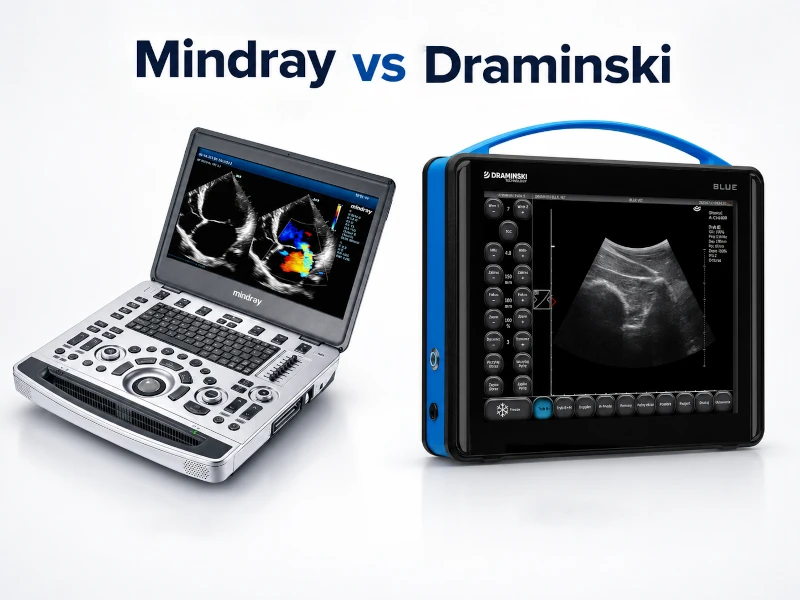
Mindray and Draminski both offer veterinary ultrasound systems, but they often appeal to different buyers. Mindray may suit clinics wanting a broader range of portable and cart-based systems, while Draminski may appeal more to vets who value portable, field-friendly veterinary scanners for horses, farm animals, and mixed practice.
Introduction
Comparing Mindray vs Draminski is not simply about deciding which brand is “better.” The stronger choice depends on the animals treated, where the system will be used, which probes are needed, and whether the buyer values clinic workflow, portability, field durability, or budget.
Mindray veterinary ultrasound systems include both cart-based and portable options designed for image quality, dedicated veterinary presets, and user-friendly workflow. Its veterinary range includes models such as Vetus E7 and Z60 Vet, along with higher-end Vetus systems for more complete clinic imaging setups. Draminski ultrasound scanners focus strongly on small animals, horses, farm animals, and field use, with systems such as BLUE, 4Vet Slim, and iScan.
This comparison looks at where each brand fits best, what buyers should compare, and which option may make more sense for different veterinary workflows.
Quick Verdict: Mindray or Draminski?
Mindray may be the better fit for clinics that want a wider range of veterinary ultrasound systems, including cart-based and portable options for small animal, mixed-practice, and general diagnostic imaging. It may also appeal to buyers who want a clinic-friendly workflow, veterinary presets, Doppler options, and a range of models to compare.
Draminski may be the better fit for vets who prioritise portability, field scanning, equine exams, farm work, reproductive imaging, and straightforward veterinary workflow. Draminski’s veterinary ultrasound range includes systems designed for small animals and horses, as well as field-focused scanners for livestock and reproductive work.
This is not a final rule. The specific model, probe package, condition, warranty, and service support matter more than the brand name alone.
Where Mindray Has the Advantage
Mindray’s main advantage is range. The brand offers both cart-based and portable veterinary ultrasound systems, which gives clinics more room to choose based on workflow and budget. A clinic that performs regular small animal ultrasound may prefer a cart-based Vetus system, while a mixed practice may compare portable options such as Vetus E7 or Z60 Vet.
Mindray may also be attractive for buyers who want veterinary presets and a more complete clinic workflow. Mindray describes its veterinary ultrasound category as including cart-based and portable systems designed to support diagnostic confidence with image quality, dedicated veterinary presets, and user-friendly workflow. The Z60 Vet is described as a portable colour Doppler system with dedicated veterinary workflow and support for both large and companion animals.
Best Mindray Fit
Mindray may be a better fit if you need a clinic-friendly system, want both portable and cart-based choices, scan mostly dogs and cats, or need a machine for general diagnostic imaging. It may also suit buyers who want a broader model range, Doppler options, reporting tools, and used or refurbished clinic equipment.
For a small animal clinic, the appeal is flexibility. For a mixed practice, the appeal is the ability to choose a system that can support multiple exam types without being limited to a field-only workflow.
Where Draminski Has the Advantage
Draminski’s advantage is practical veterinary portability. The brand is strongly associated with scanners used in equine, farm, mobile, and mixed-practice environments. Its BLUE scanner is described as a modern ultrasound scanner with Doppler ultrasonography and high-quality imaging for small animals and horses. Its 4Vet Slim is described as a high-quality imaging system for small animals and horses and as a good fit for veterinary mixed practices.
Draminski may appeal to vets who scan outside the clinic, move between locations, or need a system that is easy to set up and carry. Its veterinary ultrasound range also includes iScan, which Draminski describes as a small, light device designed to make field ultrasound more comfortable.
Best Draminski Fit
Draminski may be a better fit for equine vets, farm and livestock vets, mobile veterinarians, and mixed practices needing portability. It may also suit vets who scan in barns, stables, farms, or field conditions, especially for reproductive exams, tendon evaluation, and general portable imaging.
For these users, the buying decision often comes down to battery life, screen visibility, probe handling, durability, and how quickly the system can be used in less controlled environments.
Clinic Imaging vs Field Imaging
The biggest difference between Mindray and Draminski may be the work environment.
For a clinic that performs regular abdominal scans, soft tissue imaging, small animal exams, and possibly cardiac or Doppler work, Mindray may feel more flexible because of its wider system range. A clinic can compare cart-based systems for a dedicated imaging room or portable systems for shared use between rooms.
For a vet who travels between farms, stables, or mobile appointments, Draminski may feel more practical because many of its systems are built around veterinary portability and field usability. Draminski specifically describes portable veterinary ultrasound as useful both in the clinic and in the field, with farm and companion animal applications.
That does not mean Mindray is only for clinics or Draminski is only for field work. Mindray has portable systems, and Draminski has systems suitable for small animal and mixed-practice use. The difference is in the general buying angle: Mindray leans broader, while Draminski leans field-friendly.
Image Quality and Diagnostic Confidence
Both brands can offer useful veterinary image quality, but buyers should avoid judging image quality at brand level only. A higher-end model from either brand may perform very differently from an older, entry-level, or poorly maintained used system.
Mindray may be attractive for buyers who want a broader clinical imaging setup with veterinary workflow and model choice. Draminski may be attractive for buyers who want clear portable imaging in practical veterinary environments. For example, Draminski BLUE includes three Doppler imaging modes: Color Doppler, Power Doppler, and Pulse Wave Doppler. Mindray’s Z60 Vet is also positioned as a portable colour Doppler system with advanced veterinary features.
Instead of asking which brand has better image quality overall, buyers should ask whether the specific machine produces reliable images for the exams they perform every day.
Probe Packages Can Decide the Winner
Mindray vs Draminski often comes down to the probes included with the system. A cheaper machine with the wrong probes may be a worse purchase than a more expensive system that already includes the right setup.
Common probe needs include convex probes, linear probes, and micro-convex probes, along with rectal probes for large animal reproductive work and phased-array probes if cardiac imaging is needed.
Doppler-capable probes also matter where blood flow assessment is important. Draminski’s BLUE and 4Vet Slim product information lists multiple probe options across convex, linear, microconvex, OPU, and rectal styles, depending on configuration. Mindray buyers should similarly confirm whether the system supports the probes needed for companion animal, large animal, cardiac, reproductive, or mixed-practice exams.
Which Brand Fits Which Veterinary Buyer?
Choose Mindray If…
Choose Mindray if you need a clinic-friendly system, want portable and cart-based choices, scan mostly dogs and cats, need a system for general diagnostics, want a broader model range to compare, or are considering used or refurbished clinic equipment.
Mindray may also make sense if your practice wants a system that can support multiple users, exam presets, Doppler options, and more complete imaging workflow.
Choose Draminski If…
Choose Draminski if you need strong portability, work with horses, livestock, or mixed species, scan outside the clinic often, value simple field workflow, need a practical system for reproductive or tendon exams, or want a veterinary-focused portable scanner.
Draminski may also be suitable if your practice needs a system that can move between clinic rooms, farms, stables, and mobile appointments without feeling like a full cart-based setup.
New, Used, or Refurbished: Which Brand Is Safer to Buy?
Either brand can be a good option when comparing used portable ultrasound machines, as long as the system is properly tested and supported.
For Mindray, buyers should check model year, installed software, veterinary presets, Doppler features, probe compatibility, and whether the system fits the clinic’s imaging needs. A used Mindray cart-based system may be a good value for a clinic, but only if the probes, software, and service options are still suitable.
For Draminski, buyers should pay special attention to battery condition, screen condition, probe wear, portability accessories, and whether replacement probes or parts are available. This is especially important for systems that will be used in field or mobile settings.
For both brands, probe condition can strongly affect the real value of the purchase. A low-cost machine with worn or unsuitable probes can quickly become expensive.
Common Mistakes When Comparing Mindray and Draminski
A common mistake is comparing brand names instead of specific models. Mindray and Draminski both offer different systems, so the exact machine matters.
Another mistake is ignoring probe compatibility. The system must include or support the probes needed for abdominal, reproductive, tendon, cardiac, or soft tissue imaging.
Buyers also make mistakes when they choose by price alone, buy a portable system without checking battery health, assume every system includes Doppler, or fail to confirm warranty and service support.
It is also important not to buy a clinic-focused system for heavy field work or a field-focused system for advanced clinic imaging without checking limitations first. A good purchase should match the exam type, species, and work environment.
Final Recommendation
Mindray and Draminski are both valid veterinary ultrasound choices, but they suit different buyer profiles.
Mindray may be the stronger choice for clinics that want a broader ultrasound platform for small animal and mixed-practice imaging. It may appeal to buyers who want cart-based and portable choices, veterinary presets, Doppler options, and a clinic-friendly workflow.
Draminski may be the better fit for veterinarians who need practical portability, equine and farm usability, and field-friendly scanning. It may appeal to mobile vets, livestock vets, equine vets, and mixed practices where simple handling and flexible use matter.
The best decision comes down to the model, probes, condition, support, and the exams your practice performs most often.
FAQ
Is Mindray better than Draminski for veterinary ultrasound?
Mindray is not automatically better than Draminski. Mindray may be better for clinics that want a broader range of cart-based and portable ultrasound systems, while Draminski may be better for portable, equine, farm, and field-focused veterinary use.
Is Draminski better than Mindray for equine vets?
Draminski may be a strong option for equine vets because its veterinary ultrasound range includes systems designed for small animals and horses, with portable use in mind. The best choice still depends on the probe package, image quality, battery life, and support.
Is Mindray good for small animal clinics?
Yes, Mindray may be a good fit for small animal clinics and mixed practices, especially buyers who want a wider choice of veterinary ultrasound systems, including portable and cart-based options.
Which brand is better for farm vets?
Draminski may often be more relevant for farm vets because of its portable veterinary scanner focus, but some Mindray portable systems may also be suitable depending on probes and workflow.
Which brand is better for used ultrasound buyers?
Either brand can be a good used purchase if the system is tested and supported. Buyers should check probe condition, software options, service history, battery health for portable units, and warranty before buying.
What should I compare before choosing Mindray or Draminski?
Compare the exact model, included probes, image quality, Doppler features, portability, battery life, service support, warranty, and whether the system fits small animal, equine, livestock, or mixed-practice use.